


Entering your primary checking account debit card number into an unfamiliar online checkout page is one of the riskiest financial decisions a consumer can make. Choosing the safest online payment methods establishes an impenetrable financial firebreak between your personal bank account and potential cybercriminals. In this expert analysis by Cauitonery, we rank every mainstream digital checkout method by fraud protection, chargeback ease, and merchant data exposure.
🛡️ Key Payment Safety Takeaways
- Debit vs. Credit Distinction: Credit cards protect your cash under federal zero-liability rules; debit card fraud drains your actual liquid checking account.
- Virtual Card Tokenization: One-time virtual cards generate unique 16-digit numbers that automatically expire after a single checkout.
- Digital Wallet Security: Apple Pay and Google Pay never share your actual card details with merchant payment gateways.
- Peer-to-Peer Warning: Services like Zelle and Cash App lack merchant buyer protections; never use them for commercial purchases.
The True Cost of Payment Fraud
When an e-commerce website suffers a database breach, customer credit card numbers, expiration dates, and billing addresses are frequently leaked to dark web trading forums. If you paid using a standard debit card, unauthorized charges immediately withdraw liquid cash from your checking account. While banks eventually refund fraudulent charges, your real money can remain frozen for weeks while fraud claims are investigated.
Adopting the safest online payment methods shields your everyday savings from merchant breaches and unauthorized billing loops.
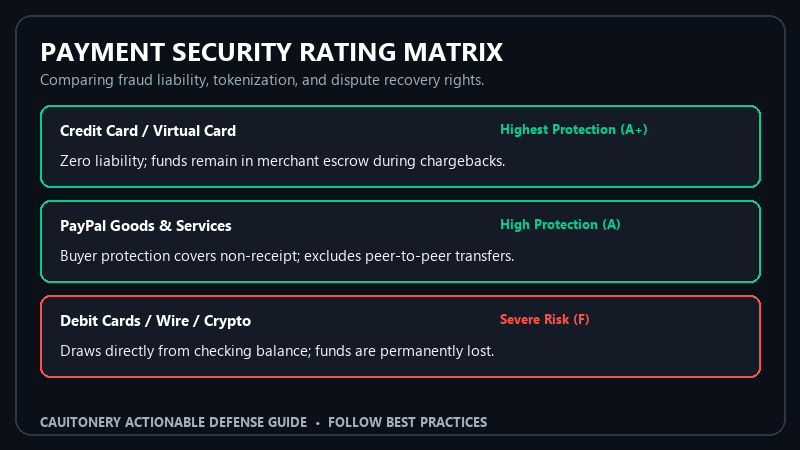
Online Payment Security Scorecard
The table below provides a side-by-side evaluation of common payment instruments across fraud liability, merchant tokenization, and chargeback ease:
Ranking the Top 4 Safest Online Payment Methods
1. Virtual Credit Cards with Spend Limits
Virtual cards generated through services like Privacy.com or Capital One Eno allow you to generate customized, temporary credit card numbers tied to a specific merchant. You can set strict spend caps (e.g., maximum $30) or create “burner cards” that automatically terminate immediately after one purchase. Even if the store database is subsequently hacked, the stolen card number is completely useless.
2. Tokenized Digital Wallets (Apple Pay & Google Pay)
When you click “Pay with Apple Pay” or “Google Pay,” the platform generates a unique, one-time Device Account Number and a cryptographic security cryptogram. The merchant never receives or stores your real credit card number. This eliminates the vulnerability of card skimmers and database compromises when shopping online or buying pre-owned electronics safely.
3. Major Credit Cards (Visa, Mastercard, Amex)
Under the federal Fair Credit Billing Act (FCBA), your statutory maximum liability for unauthorized credit card charges is capped at $50, and virtually all major card issuers provide voluntary Zero Liability guarantees. If goods arrive damaged, counterfeit, or fail to arrive at all, your bank issues a temporary credit while launching a formal merchant chargeback. When vetting new vendors, consult our guide to spotting fake online shopping websites to steer clear of shady storefronts.
4. Third-Party Payment Intermediaries (PayPal)
Paying through PayPal keeps your financial data isolated on PayPal’s secure servers, preventing the external merchant from storing your card numbers. PayPal Purchase Protection covers eligible purchases if an item does not arrive or materially differs from the seller’s description. The Consumer Financial Protection Bureau (CFPB) guidelines on card rights consistently highlight third-party tokenization as a sound consumer shield.
Payment Methods You Should Never Use for Online Shopping
Never send funds to an unknown online vendor via peer-to-peer payment networks (such as Zelle, Venmo, or Cash App), wire transfers (Western Union), or cryptocurrency. These payment rails are treated by banking regulations as digital cash. Once sent, transfers are irreversible, leaving you zero recourse if the seller fails to deliver the promised goods. Detailed guidance from the FTC Safe Online Shopping Guide warns consumers against using non-commercial transfer methods with online sellers.
Frequently Asked Questions (FAQ)
Is paying with a debit card online really that dangerous?
Yes. While debit cards offer fraud protection under the Electronic Fund Transfer Act (EFTA), the stolen funds come directly out of your living expenses account. Investigating claims can take up to 10-45 business days, leaving you unable to pay rent or bills while the bank completes its review.
Are virtual credit cards free to use?
Most virtual card services, including Capital One’s built-in virtual cards and Privacy.com’s personal tier, are completely free for standard consumer purchases, funded through normal merchant interchange fees.
Does using Apple Pay protect me if a store doesn’t deliver my item?
Yes. Because Apple Pay tokenizes the underlying credit card you selected, you retain all statutory chargeback rights and purchase protection guarantees provided by your card issuer.
What are the safest online payment methods for international transactions?
For international orders, credit cards with zero foreign transaction fees and digital wallets like PayPal offer the strongest dispute rights and favorable currency conversion protection.
