

Every day, over 15,000 fraudulent online shopping websites are created with a single objective: to siphon your hard-earned money and harvest sensitive financial data. As cybercriminals deploy sophisticated website cloning tools, recognizing a fake online shopping website has transformed from a casual precaution into an essential digital survival skill. In this comprehensive, forensic guide by Cauitonery, we analyze the 10 most critical red flags used by rogue storefronts and provide an actionable, 60-second verification checklist you can deploy before clicking “Place Order.”
🛡️ Key Consumer Takeaways
- Subtle URL Variations: Scam sites leverage typosquatting and unorthodox domain extensions like
.top,.shop, or.xyz. - Unprotected Payment Channels: Legitimate retailers never mandate payments through direct wire transfers, peer-to-peer apps, or cryptocurrency.
- Domain Registration Age: Over 82% of reported retail fraud portals were registered less than 90 days before launch.
- Consumer Recourse: Always checkout using a credit card or virtual card to retain chargeback and dispute rights.
The Anatomy of a Modern E-Commerce Scam
Modern retail scams no longer look like poorly formatted, amateur web pages from a decade ago. Fraud syndicates now scrape complete product catalogs, high-resolution imagery, and cascading stylesheets from reputable multi-national brands. They replicate identical navigation bars, checkout workflows, and trust badges within hours.
According to consumer protection agencies, the primary vector driving shoppers to a fake online shopping website is sponsored ads on social networks and search engine results. Scammers bid aggressively on trending product keywords—such as seasonal apparel, discount gaming consoles, or sold-out consumer electronics—offering steep discounts that bypass a consumer’s normal rational skepticism.
10 Critical Warning Signs to Identify a Fake Online Shopping Website
1. Unbelievable Discounts and “Clearance Warehouse” Pricing
The cardinal rule of smart buying remains undefeated: if a premium $350 outdoor jacket or a $1,200 flagship smartphone is advertised for $49 with “free worldwide shipping,” you are looking at a counterfeit portal or an outright phantom store. Fraudulent operators price high-ticket goods just low enough to trigger an impulse purchase, while avoiding numbers so absurd that they raise instant alarm.
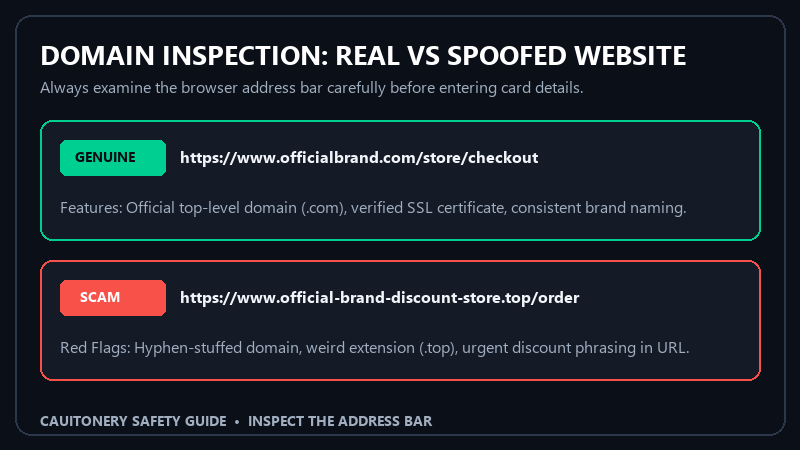
2. Deceptive Domain Names and Typosquatting Tricks
Scammers cannot register an existing, trademarked domain name like nike.com or bestbuy.com. Instead, they exploit visual deception by appending terms such as “-sale,” “-outlet,” “-official,” “-store,” or altering individual characters (e.g., swapping a lowercase “l” for a numeral “1” or letter “I”).
3. Absence of a Verifiable Physical Address and Phone Number
Every legitimate online business must provide transparent, authentic contact information. Navigate directly to the website footer and examine the “About Us” and “Contact Us” pages. Red flags include:
- Only a generic web contact form with no direct customer support email.
- A customer care email hosted on a free public domain (e.g.,
brandsupport2026@gmail.com). - A physical address that resolves to a residential apartment complex, a vacant commercial lot, or a shipping container dock on satellite maps.
- A non-functional, disconnected, or perpetually busy telephone helpline.
4. Demands for Non-Standard, Non-Refundable Payment Methods
Legitimate payment processors require rigorous merchant onboarding, business documentation, and bank guarantees. Fraudulent operators avoid merchant processors because funds can be frozen during customer disputes. Consequently, a fake online shopping website will steer customers toward irreversible transaction channels:
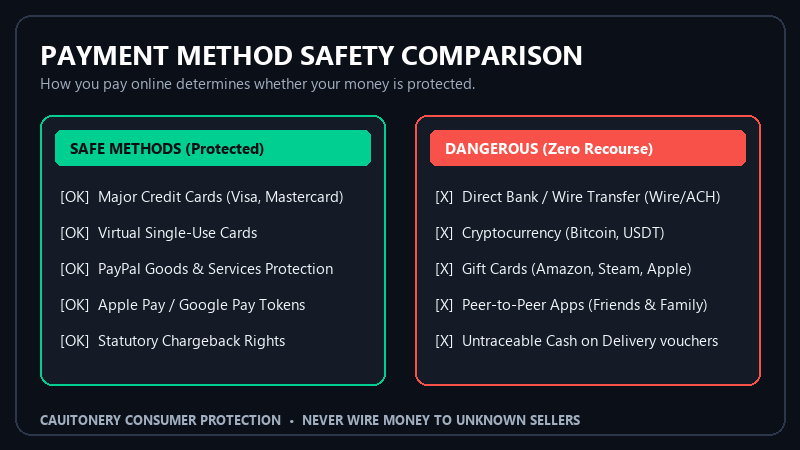
If an online shop insists on direct bank wire transfers (ACH, SEPA), Western Union, Zelle, Bitcoin, or payment via store gift cards (such as Apple or Amazon vouchers), cancel the session immediately. You will possess zero chargeback protection once the payment clears.
5. Domain Registration Age Under 6 Months
Scam websites operate on a short life cycle. Once financial institutions and cybersecurity registrars detect fraudulent chargebacks, the domain is blacklisted. Scammers abandon it and spin up a new domain the next morning.
You can verify any domain’s registration date in under thirty seconds by querying the public WHOIS registry (via whois.domaintools.com or ICANN Lookup). If a website claims to be “Serving Customers Globally Since 2012” but its domain was registered four weeks ago, you have caught the fraudster red-handed.
6. The “HTTPS Padlock” Misconception
Many consumers still believe that a green padlock icon in the browser address bar certifies that a website is genuine. This is dangerously false. An SSL/TLS certificate only guarantees that the data transmitted between your browser and the web server is encrypted against third-party eavesdropping; it does not authenticate the integrity or trustworthiness of the entity operating that server. Today, over 80% of phishing and scam domains utilize free, automated SSL certificates.
7. Stock Template Artifacts and Broken Navigation Links
Rushed scammers often leave template filler code active on secondary pages. Look closely at the footer: do social media icons (Facebook, Instagram, X) link back to genuine active brand accounts, or do they simply reload the current page or link to #? Check the “Terms & Conditions” and “Return Policy” pages. Often, they contain copy-pasted text that mistakenly references an entirely different store brand or includes unedited Lorem Ipsum dummy text.
8. Pressure Tactics and False Countdown Timers
Rogue retail sites depend heavily on manufactured urgency. You will frequently encounter flashing countdown timers stating: “Flash Sale Ends in 04:12” or pop-up notifications stating “David from New York just purchased this item 1 minute ago.” These are scripted JavaScript tricks engineered to short-circuit your critical thinking and accelerate the checkout process before you can conduct due diligence.
9. Missing or Unrealistic Return & Refund Policies
A reputable retailer outlines comprehensive return windows, warranty disclaimers, and return postage procedures. Rogue sites frequently state that returns must be shipped at the buyer’s expense to an overseas warehouse address, or enforce restocking fees that exceed 70% of the item’s purchase value. If a policy is vague, evasive, or completely absent, consider your money unrecoverable.
10. Discrepancy in External Independent Reviews
Never rely on customer testimonials published on the merchant’s own website. Fraudulent websites fabricate 5-star reviews with ease, complete with fictitious names and stock profile avatars. Instead, open a new browser tab and search for: "[Website Name] reviews" or "[Website Name] scam" across independent portals such as Trustpilot, Better Business Bureau (BBB), Reddit, or ScamAdviser.
The 60-Second Consumer Verification Protocol
Before entering sensitive credit card details into any unfamiliar digital storefront, execute this four-step verification sequence:
- Perform the WHOIS Domain Check: Confirm the domain was registered more than six months ago.
- Verify the Physical Address: Copy the corporate street address from the Contact page into Google Maps Street View to confirm an operational commercial building exists.
- Test the Support Phone / Email: Send a quick query asking about stock availability. Legitimate merchants typically respond within a reasonable business SLA; rogue sites either bounce or never respond.
- Audit the Payment Gateway: At the final payment step, confirm that you are redirected through a recognized, PCI-DSS compliant payment processor (such as Stripe, PayPal, or authorized bank gateway), rather than being asked to enter card numbers on an unsecured static form.
What to Do If You’ve Already Purchased from a Suspected Scam Website
If you realize you have transacted with a fraudulent merchant, time is of the essence. Take these immediate containment steps:
- Contact Your Card Issuer Immediately: Call the fraud department number on the back of your credit card. Request a freeze or card re-issue and formally initiate a dispute or chargeback under merchant non-fulfillment of goods.
- Update Compromised Passwords: If you created an account on the fraudulent store using a password you reuse across email or banking, update those passwords immediately and enable Two-Factor Authentication.
- Report the Fraudulent Entity: Submit a consumer complaint to the Federal Trade Commission (FTC) at
reportfraud.ftc.govor your regional digital cybercrime reporting authority.
Frequently Asked Questions (FAQ)
Can I get my money back if I paid via bank transfer to a fake website?
Recovering funds sent via direct bank transfer or wire is notoriously difficult once the money has been withdrawn by the recipient. You must contact your bank’s fraud unit immediately; in rare instances where funds are still in transit, an emergency recall may be possible.
Why do search engines allow fake shopping websites to appear in ad results?
While search platforms utilize automated policy enforcement, sophisticated fraud syndicates use cloaking technology to present compliant content to ad review bots, only serving the scam storefront to genuine consumer IP addresses. Never assume that a sponsored search result is automatically legitimate.
Does paying with a credit card protect me from fake online stores?
Yes. Under the Fair Credit Billing Act (FCBA) and Visa/Mastercard zero-liability frameworks, credit card purchases carry robust dispute rights that enable consumers to reverse transactions if merchandise is never delivered or is demonstrably counterfeit.
