




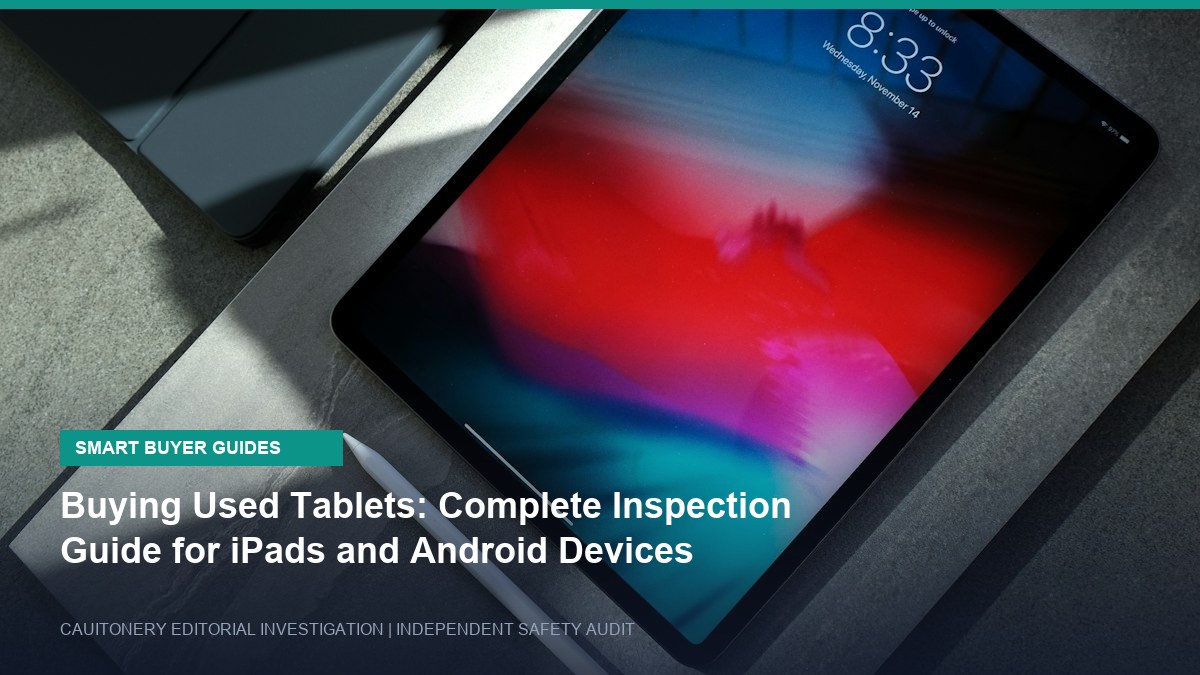
Purchasing pre-owned tablets is one of the most effective strategies for securing premium mobile computing and digital illustration performance at a fraction of retail cost. However, the secondary market is fraught with hidden hardware defects, severely degraded lithium-ion cells, and permanent cloud activation locks. Utilizing our structured buying used tablets guide ensures you invest exclusively in durable, fully functional hardware.
The Critical Risks of Secondary Tablet Transactions
Unlike standard laptop computers where components can be swapped or operating systems reinstalled via USB drives, modern tablets are tightly sealed, monolithic devices. Displays, digitizers, logic boards, and battery cells are permanently bonded with industrial adhesive. A single undetected defect—such as an iCloud Activation Lock or a damaged display controller—can render the purchase an unrepairable paperweight.
| Inspection Stage | Quick Visual Check | Deep Hardware Diagnostic | Immediate Dealbreaker |
|---|---|---|---|
| Cloud Security Lock | Appears on Home Screen | Full Device Wipe & Setup Completed in Person | iCloud / Google FRP Lock Active |
| Battery Health | Shows 100% Charge | Cycle Count Audited via Diagnostic Software | Battery Capacity Under 80% / Bulging Display |
| Digitizer Grid | Swipes Home Screen | Drawing App Full Surface Grid Test | Dead Touch Zones or Apple Pencil Jitter |
| Chassis Integrity | No Major Scratches | Sight Down Aluminum Edge for Frame Warping | Bent Frame / Compromised Internal Seal |
The 5-Step In-Person Tablet Inspection Protocol
1. Verify Complete Cloud De-Registration in Person
The single most catastrophic mistake when purchasing a used iPad or Android tablet is accepting a device that has not been completely disassociated from the previous owner’s cloud account. For Apple devices, ensure Find My iPad and Activation Lock are completely disabled. Witness the seller perform a fresh factory reset (Settings > General > Transfer or Reset iPad > Erase All Content and Settings) and complete the initial setup screen to reach the home screen without encountering an Apple ID password prompt.
2. Execute the Full-Screen Touch Digitizer Test
A tablet with a cracked sub-surface digitizer may register central finger taps while remaining unresponsive around the perimeter. Open a pre-installed drawing or notes application. Using your finger (or compatible stylus), methodically draw dense grid lines covering 100% of the display from corner to corner. Any gaps, skipped lines, or erratic ghost inputs indicate localized digitizer failure requiring expensive glass replacement.
3. Audit True Battery Health and Cycle Counts
Tablets subjected to intense daily gaming or continuous retail POS kiosk charging suffer rapid battery degradation. While iPads do not natively show battery health in settings like iPhones, you can connect the tablet to a laptop running diagnostic tools such as coconutBattery (macOS) or 3uTools (Windows) to verify the genuine cycle count and remaining milliamp-hour (mAh) capacity. Reject any device exhibiting over 800 charge cycles or under 80% maximum capacity.
4. Inspect for Third-Party Screen Replacements
Low-quality aftermarket replacement screens suffer from poor color reproduction, lower refresh rates, and broken biometric sensors. On iPads, navigate to Settings > Display & Brightness and verify whether True Tone functionality is present. If True Tone is missing on a supported model, the display was replaced without transferring the ambient light calibration data.
5. Test Ports, Speakers, and Biometric Hardware
Bring a high-wattage USB-C charger and power bank to the meeting. Verify that the port negotiates fast charging immediately without requiring the cable to be held at an angle. Test Face ID or Touch ID registration, play audio across all quad-speakers to detect torn diaphragms, and verify camera autofocus functionality.
Frequently Asked Questions About Used Tablets
Can an iCloud-locked iPad be bypassed permanently?
No. Hardware-level Activation Lock is enforced directly on Apple’s authentication servers. Third-party “bypass” tools are unstable, non-persistent, disable cellular/iMessage features, and break entirely upon the next operating system update.
How many years of software updates should a used tablet have remaining?
For long-term security, aim for devices that have at least 2 to 3 years of guaranteed operating system and security patch support remaining from the manufacturer.


